Tuesday, May 14, 2019

Seti Merenptah’s Stele


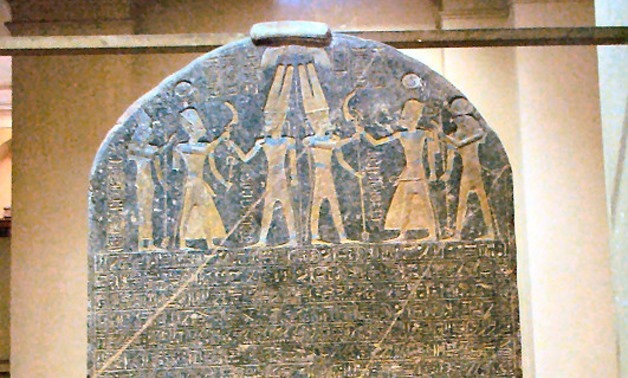
Merneptah Stele - Webscribe, Wikimedia Commons

by
 
Damien F. Mackey


Bimson thought (at least as late as 1980) that Merenptah’s Stele had pre-dated
the fall of Samaria by about a decade, to c. 734-733 BC; it being a reference rather
to the earlier Assyrian deportations of Israel by Tiglath-pileser III.


To recall what I have written previously:
 
– According to Courville, as we have seen, the stele’s inscription pertains to the Assyrian deportation of Samaria in c. 722/721 BC.
 
– Velikovsky would later look to connect it with the deportation of the Jews to Babylon after the sack of Jerusalem by Nebuchednezzar II [Ramses II and His Time, pp. 189-196]. Though Bimson has estimated Velikovsky’s date for the 5th Year of Merenptah at “no earlier than 564 BC … 23 years after the fall of Jerusalem” [‘An Eighth Century Date for Merenptah’, p. 57].
 
– Bimson thought (at least as late as 1980) that Merenptah’s Stele had pre-dated the fall of Samaria by about a decade, to c. 734-733 BC; it being a reference rather to the earlier Assyrian deportations of Israel by Tiglath-pileser III. …. [Ibid. See also ‘John Bimson replies on the “Israel Stele”,’ pp. 59-61].
 
– Rohl has in turn dated the conquests described in the stele to those effected by Seti I and Ramses II, his candidate for the biblical ‘Shishak’, himself regarding the stele as being Merenptah’s merely basking in the glory of what these, his great predecessors, had achieved before him. […. A Test of Time, ch. 7, pp. 164-171].
 
[End of quote]
 
For Drs. Velikovsky, Courville and Bimson (back then), this Egyptian Stele was supposedly commemorating one or another Assyro-Babylonian triumph – a most unlikely scenario! 
 
And Rohl, for his part, though regarding the document as being a commemoration of Egyptian victories, considered these to be triumphs pre-dating pharaoh Merenptah – victories by his predecessors, Seti I and Ramses II.  
 
Only Martin Sieff, amongst the revisionists, had envisaged this as being an Egyptian victory achieved by Merenptah himself.
 
Thus I wrote:
 
– And Sieff … related Merenptah’s victory to what he called the “time of troubles in the northern kingdom of Israel after the death of Jeroboam II”.
 
Martin Sieff’s realistic version, which is the one that I basically embraced in my postgraduate university thesis (Volume One, Chapter 11, pp. 300-305):
 
A Revised History of the Era of King Hezekiah of Judah
and its Background
 
 
was dependent upon the biblical chronology of Martin Anstey - and taken up by Philip Mauro - that the reign of Jeroboam II in Israel was followed by a 22-year period of interregnum.
 
Patrick Clarke
 
Rohl’s revised chronology, according to which Ramses II was the biblical pharaoh “Shishak” at the time of king Rehoboam of Judah (I Kings 14:25), has recently been picked up by Creationist, Patrick Clarke in his article, “The Stele of Merneptah—assessment of the final ‘Israel’ strophe and its implications for chronology”:
 
 It is clear that the Merneptah stele can be interpreted in line with the United and Divided Monarchy Periods of Israelite history. Furthermore, if it can be demonstrated that Merneptah’s father, Ramesses II, was in fact Shishak, many synchronisms previously held by both supporters of the CEC [conventional] and revisionists between the people of Israel and their neighbours collapse, and a whole new series of compelling synchronisms emerges. The reigns of Ramesses II and Merneptah are contemporaneous with the last few years of the United Monarchy and the first 75 years of the Divided Monarchy. A detailed analysis of the ‘Israel’ text indicates that far from being placed in the 1200s bc, Merneptah’s reign should be dated to 913–903 bc; a movement of three centuries. Consequently, Ramesses II would have reigned from 979–913 bc, in the Divided Monarchy Period. In my proposed revised chronology all the political, military, and economic factors detailed on the stele coincide with conditions in Israel. This was not the case three centuries earlier in the time of the Judges.
[End of quote]
 
Whilst Clarke is correct in rejecting the conventional location of the Merenptah Stele to the approximate period of “the Judges”, his chronological re-setting of Ramses II and Merenptah has, in my opinion, dire consequences for the best efforts of the revision as explored by the likes of Drs. Velikovsky and Courville, and modified and enhanced by astute minds of the “Glasgow School” (including Martin Sieff).
For, as Clarke goes on to write:
 
Once this historical re-alignment takes place, a number of synchronisms previously held to be true by some revisionists, albeit well-intentioned, are refuted. Some of these erroneous synchronisms are: Thutmose III/Shishak;31 Hatshepsut/Queen of Sheba;32 Amenhotep II/Zerah the Cushite; Israel’s King Ahab/Battle of Qarqar; Israel’s King Jehu/Shalmaneser III—the final two failed synchronisms in this list have serious implications for the less than reliable Assyrian chronology.33
[End of quote]
 
No thank you. I myself shall stick with the, now manifold, synchronisms - as worked out by revisionists - between Egypt’s 18th dynasty and the United to Early Divided kingdom periods, especially those iron-cast synchronisms with El Amarna.
 
Clarke’s most useful contribution is, in my opinion, his expertise in Egyptian Hieroglyphics, which he has correctly noted has not been a strong suit amongst revisionists: “Knowledge of the Egyptian language and syllabic orthography is essential when assessing any Egyptian text, otherwise mistakes are inevitable”. Thus Clarke writes with regard to the Stele: 
 
This reliance in Christian works on blind copying of old, outdated translations, which probably reflects the dearth of competent archeology and history specialists in the Christian community, is fraught with problems, as will be seen.
 
Knowledge of the Egyptian language and syllabic orthography is essential when assessing any Egyptian text, otherwise mistakes are inevitable. The majority of Egyptologists are in agreement regarding the entity ysry3l as Israel based on the syllabic orthography of the name and the context of the final poetic unit of the Merneptah stele. It is the chronological placement of Israel where scholars of the CEC and revisionist positions come into conflict.
[End of quote]
 
Clarke is particularly scathing about professor Joseph Davidovits, whom he calls “A secularist”, regarding the latter’s unorthodox translation of the Victory Stele (see Clarke’s section on p. 62: “A secularist attempt to deny Israel is even mentioned on the stele”).
 
A suggested solution
 
With my modification of the Nineteenth Egyptian Dynasty in its relation to Seti and the awkward Third Intermediate Period in multi-part series such as:
 
Smendes and Shoshenq I
 
beginning with:
 
 
and:
 
Seti I and Seti II Merenptah
 
beginning with:
 
 
I am now inclined to accept Rohl’s and Clarke’s opinion that the Israel Stele pertains to an early Nineteenth Dynasty ruler, such as Seti – but with my twist to this, that Seti was Merenptah.
 
See especially my article on this:
 
Seti I and Seti II Merenptah. Part Three: Seti I and II Merenptah and Merenptah
 

Thursday, May 9, 2019

Can Sargon II’s Si’be be tied up with the biblical pharaoh ‘So’?


Image result for shabaka egypt


Part One: Tying up, all together, So, Si’be and Shabaka


by
Damien F. Mackey
  
Others, though, claim that Si’be equates to Shabaka of the 25th Ethiopian dynasty ….
Boutflower had in fact looked to tie up, all together, ‘So’, Sibe and Shabaka ….
 
 
The 25th so-called ‘Ethiopian’ dynasty (c. 745 - 655 BC, conventional dating) is part of the nightmare that is Egypt’s so-called Third Intermediate Period (TIP). And though certain Egyptologists have breathed a sigh of relief when they arrived at discussion of the 25th dynasty, even that dynasty, as I attempted to explain in my article:
 
Piankhi same as Bible's Tirhakah? Part Two: 25th (Ethiopian) Dynasty not clear cut
 
https://www.academia.edu/37479175/Piankhi_same_as_Bibles_Tirhakah_Part_Two_25th_Ethiopian_Dynasty_not_clear_cut

is “not clear cut”.
The whole thing is, however (I suspect), a nightmare more of the making of the Egyptologists than of the actual reality. It is most unlikely, for instance, that Piankhi (Piye) was running about as early as c. 745 BC where convention has so early placed him.
If I am correct (following Sir Flinders Petrie), then:

Piankhi [is the] same as Bible's Tirhakah

https://www.academia.edu/37451966/Piankhi_same_as_Bibles_Tirhakah

It would certainly be nice if we could get some sort of co-ordinating perspective on such things.
Well perhaps, if we take notice of Charles Boutflower and Sir Alan Gardiner, we may be able to tie up, all at once (i) a 25th dynasty pharaoh, (ii) an Egyptian encountered by neo-Assyria, and (iii) a biblical king.
This is what I wrote about such an intriguing possible situation (or era) in my university thesis:

A Revised History of the Era of King Hezekiah of Judah
and its Background
 
AMAIC_Final_Thesis_2009.pdf

(Volume One, pp. 377-378):

When next Assyria encounters Egypt, in c. 720 BC in the reign of Sargon II, no pharaoh is initially referred to, but Egypt’s Turtan, Si’be.[1] Gardiner had in fact identified the latter with ‘So’, claiming that scholars are in agreement with this[2] (see next page). Whilst chronologically I might be able to accept this conclusion, it would not explain why a ‘King So’ has all of a sudden become a mere Turtan (Si’be). Kitchen, however, had argued that Si’be should instead read Re-e (in the Akkadian) and Ria’a (in the Egyptian).[3] Clapham has seized upon this as being an opportunity to identify the Turtan of the Egyptian armies with a Ramesside (‘Ramses’ = Ria’a) - late 19th dynasty as applicable to his own revision.[4]
Others, though, claim that Si’be equates to Shabaka of the 25th Ethiopian dynasty.[5] Boutflower had in fact looked to tie up, all together, ‘So’, Sibe and Shabaka.[6]
According to Gardiner, however, a connection between Si’be and Shabaka is unlikely:[7]

Scholars are agreed to identify this So with Sib’e, turtan of Egypt, whom the annals of Sargon state to have set out from Rapihu (Raphia …) together with Hanno … of Gaza …. Sargon tells us that Sib’e, ‘like a shepherd whose flock has been stolen, fled alone and disappeared …’. For phonetic and probably also chronological [sic] reasons So and Sib’e cannot be … Shabako, so that these names are supposed to have been those of a general. This seems the more probable since the Assyrian text goes on to say “I received the tribute from Pir’u of Musru …” which can hardly mean anything but ‘from the Pharaoh of Egypt’.

Finally, Rohl has made the suggestion that would appear to have at least real phonetic value, that “we might find the true identity of Si’be in the 21st Dynasty king Psibkhenno, more commonly known by the classical name of Psusennes”.[8]
 
[End of quotes]

For my revised view of Psusennes, see my article:

Smendes and Shoshenq I. Part Three: May Psusennes I and II be the actual same person?

https://www.academia.edu/39036650/Smendes_and_Shoshenq_I._Part_Three_May_Psusennes_I_and_II_be_the_actual_same_person

Now, what if we could tie up, all together, So and Si’be with pharaonic names from two supposed TIP dynasties: Psibkhenno/Psusennes and Shabaka?

That would give us even more chronological space in which to manoeuvre.


[1] D. Luckenbill, Ancient Records of Assyria and Babylonia, vol. II, # 5. Luckenbill gives the name here as Sib’u.
[2] Op. cit, p. 342.
[3] Op. cit, p. 373.
[4] Op. cit, p. 3.
[5] E.g. K. LeFlem, ‘Amenophis, Osarsiph and Arzu’, p. 15.
[6] Op. cit, p. 126.
[7] Op. cit, ibid.
[8] ‘Comments by David Rohl’, p. 19.

Friday, May 3, 2019

Nebuchednezzar - mad, bad, then great


Image result for mad nebuchadnezzar

by
Damien F. Mackey
Whilst, in conventional terms, Nebuchednezzar II did not begin to reign until c. 605 BC, about 80 years after the death of Hezekiah (c. 686 BC), according to the revision proposed [here], Nebuchednezzar’s  youth would have overlapped with the late reign of Hezekiah.
  
“Bagoas” and Esarhaddon
Little did I realise at the time, when invited in the Year 2000 by professor Rifaat Ebied to choose between the era of King Hezekiah and the era of King Josiah for the subject matter of a doctoral thesis (for more on this, see:
King Hezekiah of Judah and his amazing contemporaries
that Hezekiah’s and Josiah’s were in fact the very same era, that Hezekiah was Josiah.
My article:
explains the revision that I have more recently set out for the later kings of Judah.
But so radical a revision of Judah must needs be accompanied by, for instance, a similarly radical revision of whoever Assyro-Babylonian dynasts were contemporaneous with these kings of Judah. Amongst the articles that I have written on that score are:
Aligning Neo Babylonia with Book of Daniel. Part One: Shortening the Chaldean Dynasty
and the more important:
Aligning Neo-Babylonia with Book of Daniel. Part Two: Merging late neo-Assyrians with Chaldeans
The upshot of all this is, in the case of the Nebuchednezzar the Great, that his life now comes within close range of King Hezekiah.
Whilst, in conventional terms, Nebuchednezzar II did not begin to reign until c. 605 BC, about 80 years after the death of Hezekiah (c. 686 BC), according to the revision proposed above, Nebuchednezzar’s  youth would have overlapped with the late reign of Hezekiah.
And, if the Jewish tradition be correct, that the future Nebuchednezzar II himself had participated in Sennacherib’s ill-fated campaign at the time of king Hezekiah - quite a chronological impossibility in conventional terms - then Nebuchednezzar may even be the wrongly-named “Bagoas”, who was second-in-command to (Ashur-nadin-shumi =) “Holofernes” himself. See e.g. my article:
An early glimpse of Nebuchednezzar II?
Now, if Sennacherib’s eldest son, Ashur-nadin-shumi, was “Holofernes”, the leader of the disastrous invasion of Israel by the 185,000 Assyrians, then who was – where was? – Esarhaddon in all of this, he being the son who would most unexpectedly succeed Sennacherib? Well, if Nebuchednezzar had in fact been personally involved in this campaign, as according to Jewish tradition, then that, too, is where we must find Esarhaddon, at least if I am correct that:
"As we know from the correspondence left by the roya1 physicians and exorcists … [Esarhaddon’s] days were governed by spells of fever and dizziness, violent fits of vomiting, diarrhoea and painful earaches. Depressions and fear of impending death were a constant in his life. In addition, his physical appearance was affected by the marks of a permanent skin rash that covered large parts of his body and especially his face". (Karen Radner)
In a multi-part “Nebuchednezzar syndrome” series, I have listed and described a number of Assyro-Babylonian (and even supposedly Persian) kings who have the earmarks of the biblico-historical Nebuchednezzar: dreams; illness-madness; interfering with rubrics; building Babylon; invasion of Egypt, megalomania; fiery furnace; revival and ‘conversion’: 
Esarhaddon, in particular, seems to ‘scream out’ to be identified with Nebuchednezzar.
It was only late in this series that I realised that I even had to include the Babylonian, Nabopolassar, in the list. He is generally considered to have been the father of Nebuchednezzar. “Nebuchednezzar syndrome” features (not listed above) that I began to pick up with Nabopolassar were other common ones such as, not expecting to be named king; and an almost fanatical precision about foundation alignment.   
Ashurbanipal; Nabonidus; Cambyses
      “Fragments of a Scroll found near the Dead Sea likely makes an amazing reference to
the prophet Daniel. The fragment, found in a cave located along the cliffs overlooking
the Dead Sea, is known as the "Prayer of Nabonidus."
biblehistory.net
Apart from the many “Nebuchednezzar syndrome” parallels, see Part One:
https://www.academia.edu/39005954/The_many_faces_of_Nebuchednezzar._Part_One_Bagoas_and_Esarhaddon Nabonidus, supposedly ‘centring himself upon Ashurbanipal’, has further striking likenesses to Ashurbanipal:
Ashurbanipal and Nabonidus
and has striking likenesses to the biblical “Nebuchednezzar”:
Does King Nabonidus reflect Daniel's "Nebuchednezzar"?
In an intriguing article, “The Prophet Daniel”:
we read this:
 Fragments of a Scroll found near the Dead Sea likely makes an amazing reference to the prophet Daniel. The fragment, found in a cave located along the cliffs overlooking the Dead Sea, is known as the "Prayer of Nabonidus." The artifact, which  doesn't seem to draw much attention in Biblical archaeology circles, is actually very important. First of all it is a copy of a scroll written in the language of Babylon, Aramaic, not Hebrew as in the case of the majority of the Dead Sea Scrolls. Aramaic was the language spoken in ancient Babylon. The reason this is important is because Daniel the prophet was educated in the Aramaic language of Babylon. We found this stated in Daniel 1:4 and in Daniel 2:4.
….
Prayer of Nabonidus
There is also evidence that the original book of Daniel from chapters 2:4 through chapters 7:28 were also written in this ancient Aramaic language known as Chaldee (the language of Babylon), the same language used in Babylonian documents of the 7th century B.C.
This evidence comes from other Dead Sea Scroll fragments found of the book of Daniel. These fragments confirm the fact that the events spoken of in the book of Daniel were written down by Daniel in ancient Aramaic during the time of his captivity in Babylon.
Now the text of the "Prayer of Nabonidus" is an account of the Babylonian king Nabonidus, the father of the Biblical ruler Belshazzar. In his account, Nabonidus had come down with a disease while away from Babylon at his stay at the oasis city of Teman in Saudi Arabia. He prayed to his false gods and idols of silver, gold, wood, stone and clay, but to no avail. So he sought the help from a Jew who was part of the exiles taken into captivity back to Babylon. This Jew tells Nabonidus to worship and honor the Most High God instead of his foreign gods.
This Jew, referred to here, is most likely the prophet Daniel. We know from Scripture that Daniel was still alive during the reign of Nabonidus and his son Belshazzar. Scripture also indicates that the Queen of Babylon, likely the Queen of Nabonidus, Belshazzar's mother, believed that Daniel was, in her words, "A man in the kingdom in whom dwelt the Spirit of the Holy God, . . . like the wisdom of the gods whom Nebuchadnezzar your father (grandfather) - your father the king (Nabonidus) - made him chief of the magicians. astrologers, Chaldeans, and soothsayers." Daniel 5:11
      So Daniel was considered to be the chief man to go to under both king Nebuchadnezzar and king Nabonidus when dealing with issues concerning God.
       Now, these fragments of the scroll give evidence outside of the Bible that Nabonidus likely called upon Daniel's advise after his prayers to his false gods had failed.
  Below is one English translation of the scroll fragments known as the Prayer of Nabonidus 4Q242.
 
1) The words of the prayer which Nabonidus, king of Babylon, the great king, prayed when he was stricken
2) with an evil disease by the decree of God in Teman. I Nabonidus was stricken with an evil disease
3) for seven years, and from that time I was driven and I prayed to the Most High
4) and, as for my sin, he forgave it. A diviner – who was a Jew of the Exiles – came to me and said:
5) ‘Recount and record these things in order to give honor and greatness to the name of the God Most High.’ And thus I wrote: I
6) was stricken with an evil disease in Teman by the decree of the Most High God, and, as for me,
7) seven years I was praying to gods of silver and gold, bronze, iron,
8) wood, stone and clay, because I thought that they were gods. ….

Cambyses too, apart from having some of the earmarks of “Nebuchednezzar syndrome”: madness; conquest of Egypt, had the alternative name of “Nebuchadnezzar”:
Cambyses also named Nebuchadnezzar? Part Three: ‘Sacred disease’ (read madness) of King Cambyses
And, perhaps further strengthening the contemporaneity of Cambyses with the neo-Assyrian era, I have suggested an identification of the important official in Egypt, Udjahorresne[t], who acted as the king’s guide and mentor there, with Ushanahuru, the son (possibly Crown Prince) of the great Tirhakah of Egypt/Ethiopia:
Cambyses mentored in Egypt by Udjahorresne. Part One: Too many invasions of Egypt
Cambyses mentored in Egypt by Udjahorresne. Part Two: Meeting and identifying Udjahorresne


‘Artaxerxes king of Babylon’
‘But in all this time was not I at Jerusalem: for in the two and thirtieth year of Artaxerxes king of Babylon came I to the king, and after certain days obtained I leave of the king’.
Nehemiah 13:6
There are two kings “Artaxerxes” with whom Nebuchednezzar appears to have a greater, or lesser, connection.
The first is Artaxerxes III ‘Ochus’, who I claim to be another of those fictitious, late production characters, a composite based upon real Mesopotamian kings – most notably Sennacherib and Nebuchednezzar.  
Emmet Sweeney had, in the 1990’s, identified Artaxerxes III ‘Ochus’ with Nebuchednezzar (see E. Scott’s Hatshepsut, Queen of Sheba, pp. 170-171)
For my own articles on the subject, see e.g:
Artaxerxes III and Judith
and:
"Nebuchednezzar Syndrome": dreams, illness-madness, Egyptophobia. Part Two: Ashurbanipal; Nabonidus; Cambyses; Artaxerxes III
and:
Medo-Persian History Archaeologically Light. Part Three: Artaxerxes III ‘Ochus’
The Artaxerxes of the Book of Nehemiah is quite a different matter.
He is a real flesh and blood king, who has been badly mis-identified and mis-dated.
He is, again, Nebuchednezzar the great King of Babylon. See my multi-part series:
Governor Nehemiah's master "Artaxerxes king of Babylon". Part One: Nehemiah and that ‘broken down wall’
commencing with:
Finally, also to be considered for a ‘face’ of King Nebuchednezzar - given the need to fold the Middle Babylonian period with the Neo Babylonian period - is Nebuchednezzar I.
This is what I wrote on the matter in:
King Hezekiah of Judah and his amazing contemporaries
…..
My other move on Sennacherib at that time involved the necessary (in terms of the revision) folding of Middle Assyro-Babylonian history with Neo Assyro-Babylonian history.
Revised attempts at this so far do not seem to have been very successful.
I thought that I had found the perfect solution with my folding of the mighty Middle Babylonian king, Nebuchednezzar I, conventionally dated to the C12th BC - he, I then declared to have been ‘the Babylonian face’ of Sargon II/Sennacherib.
Such an identification, which seemed to have massive support from the succession of Shutrukid-Elamite kings of the time having names virtually identical to the succession of Elamite kings at the time of Sargon II/Sennacherib … had the further advantage of providing Sargon II/Sennacherib with the name, “Nebuchednezzar”, just as the Assyrian king is named in the Book of Judith (“Nebuchadnezzar”).
My more recent collapsing of the late neo-Assyrian era into the early neo-Babylonian era has caused me to drop the identification of Nebuchednezzar I with Sargon II/Sennacherib:
More appropriately, now, Nebuchednezzar I might be found to have been Nebuchednezzar II.
Fortunately though, with this tightened chronology, the impressive Shutrukid-Elamite parallels that I had established in my thesis might still remain viable.
Having rejected my former folding of Nebuchednezzar I with Sargon II/Sennacherib the question must be asked, ‘At what point does Middle fold with Neo?’
This all awaits further potential development.

Wednesday, May 1, 2019

Can this be the Seal of the prophet Isaiah?


 Image result for seal isaiah


“Researchers found a bulla believed to have been created using one of King Hezekiah's seals in one of these temples just three years ago. Another bulla has been the object of scrutiny ever since, and now, Mazar is suggesting the possibility that it came about from a seal belonging to the prophet Isaiah”.
 
Bob Yirka


An article dated February 23, 2018, by Bob Yirka, tells of the finding of a Seal perhaps belonging to the prophet Isaiah:
https://phys.org/news/2018-02-clay-extra-biblical-prophet-isaiah.html
 
Clay print from seal may be first ever extra-biblical reference to the prophet Isaiah
….
 
Credit: Biblical Archaeology Review 44:2, March/April May/June 2018
 
Author and archaeologist Eilat Mazar has published an article in Biblical Archaeology Review suggesting that a small piece of clay with a seal imprint on it (called a bulla) might be the first-ever extra-biblical reference to the prophet Isaiah.
 
In her article, she gives a historical overview of both King Hezekiah and the prophet Isaiah, followed by an overview of the locations in which both people were believed to have lived and worked—specifically temples in Jerusalem that have been under excavation for many years.
 
Researchers found a bulla believed to have been created using one of King Hezekiah's seals in one of these temples just three years ago. Another bulla has been the object of scrutiny ever since, and now, Mazar is suggesting the possibility that it came about from a seal belonging to the prophet Isaiah.
 
Isaiah was a Jewish prophet who lived approximately 2,700 years ago, and who has long been linked with King Hezekiah. It was Isaiah, according to the Hebrew Bible, who encouraged the King to fight the Assyrians who had attacked Jerusalem in 701 BC, rather than allow them to surrender—he promised that God would not let Jerusalem be captured. The second bulla under study was found close to (just 3 meters away) the one believed to be created by the King's seal, offering some bit of hint at its source. But more important is a word found on the imprint, "Yesha'yahu," which is Hebrew for Isaiah.
 
Unfortunately, another important part of the print has been lost. It starts with "nvy." Nobody knows what it means, but Mazar notes that if the letters were followed by "aleph," the whole thing would form the Hebrew word for prophet. Thus, the seal would have been used to make bullas as a form of receipt from the prophet Isaiah. Mazar does not know if the remaining parts of the bulla will be found, but notes that nvy by itself could be part or all of a personal name, one that did not belong to the prophet. On the other hand, she further notes, there are places in the Hebrew Bible where nvy is used as an apparent abbreviation for prophet.