Thursday, April 14, 2016

Judith the Simeonite and “Judith the Semienite”


https://s-media-cache-ak0.pinimg.com/736x/b5/94/20/b594208821c836eea42fb5d53e9faab8.jpg
by
 
Damien F. Mackey
 
The history books tell of various strong female characters - whether real or not - the accounts of whom seem to have picked up traces of the great Jewish heroine, Judith of Simeon.
One of these, Queen Judith of Semien (NW Abyssinia), reads somewhat like the biblical Judith, now transported in time (AD) and space (Ethiopia).


Judith Types Emerging Throughout 'History'?

Donald Spoto has named a few of these “types” - {but many more names could be added here} - in his book, Joan. The Mysterious Life of the Heretic Who Became a Saint (Harper, 2007). Spoto, likening Joan of Arc to an Old Testament woman, has a chapter five in which he calls her “The New Deborah”.
Saint Joan has also been described as a “second Judith”. See my:
 
Judith of Bethulia and Joan of Arc
 
 
Both Deborah and Judith were celebrated Old Testament women who had provided military assistance to Israel.
Let us read of what Spoto has to say on the subject, starting with comparisons with some ancient pagan women (pp. 73-74):
 
Joan was not the only woman in history to inspire and to give direction to soldiers. The Greek poet Telesilla was famous for saving the city of Argos from attack by Spartan troops in the fifth century B.C. In first-century Britain, Queen Boudicca [Boadicea] led an uprising against the occupying Roman forces. In the third century Zenobia, Queen of Palmyra (latter-day Syria), declared her independence of the Roman Empire and seized Egypt and much of Asia Minor. Africa had its rebel queen Gwedit, or Yodit, in the tenth century. In the seventh appeared Sikelgaita, a Lombard princess who frequently accompanied her husband, Robert, on his Byzantine military campaigns, in which she fought in full armor, rallying Robert’s troops when they were initially repulsed by the Byzantine army. In the twelfth century Eleanor of Aquitaine took part in the Second Crusade, and in the fourteenth century Joanna, Countess of Montfort, took up arms after her husband died in order to protect the rights of her son, the Duke of Brittany. She organized resistance and dressed in full armor, led a raid of knights that successfully destroyed one of the enemy’s rear camps.
Joan [of Arc] was not a queen, a princess, a noblewoman or a respected poet with public support. She went to her task at enormous physical risk of both her virginity and her life, and at considerable risk of a loss of both reputation and influence. The English, for example, constantly referred to her as the prostitute: to them, she must have been; otherwise, why would she travel with an army of men?
Yet Joan was undeterred by peril or slander, precisely because of her confidence that God was their captain and leader. She often said that if she had been unsure of that, she would not have risked such obvious danger but would have kept to her simple, rural life in Domrémy.
[End of quote]
 
Some of these above-mentioned heroines, or amazons, can probably be identified with the ancient Judith herself – she gradually being transformed from an heroic Old Testament woman into an armour-bearing warrior on horseback, sometimes even suffering capture, torture and death. Judith’s celebrated beauty and/or siege victory I have argued on other occasions was picked up in non-Hebrew ‘history’, or mythologies: e.g. the legendary Helen of Troy is probably based on Judith, at least in part, in relation to her beauty and to a famous siege, rather than to any military noüs on Helen’s part. And, in the “Lindian Chronicle” of the Greco-Persian wars, in a siege of the island of Hellas by admiral Darius, also involving a crucial five-day period, as in the Book of Judith, the goddess Athene takes the place of Judith in the rôle of the heroine, to oversee a successful lifting of the siege.
In the name Iodit (Gwedit) above, the name Judith can, I think, be clearly recognised.
The latter is the same as Queen Judith of Semien (960 AD). https://en.wikipedia.org/wiki/Gudit
 
Gudit (Ge'ez: ጉዲት, Judith) is a semi-legendary, non-Christian, Beta Israel queen (flourished c. 960) who laid waste to Axum and its countryside, destroyed churches and monuments, and attempted to exterminate the members of the ruling Axumite dynasty[citation needed]. Her deeds are recorded in the oral tradition and mentioned incidentally in various historical accounts.
Information about Gudit is contradictory and incomplete. Paul B. Henze wrote, "She is said to have killed the emperor, ascended the throne herself, and reigned for 40 years. Accounts of her violent misdeeds are still related among peasants in the north Ethiopian countryside."[1]
[End of quote]
 
Interesting that Judith the Simeonite has a “Gideon” (or Gedeon) in her ancestry (Judith 8:1): “[Judith] was the daughter of Merari, the granddaughter of Ox and the great-granddaughter of Joseph. Joseph’s ancestors were Oziel, Elkiah, Ananias, Gideon, Raphaim, Ahitub, Elijah, Hilkiah, Eliab, Nathanael, Salamiel, Sarasadai, and Israel” … and the Queen of Semien, Judith, was the daughter of a King Gideon.
That the latter is virtually a complete fable, however, is suspected by Bernard Lewis
 
Bernard Lewis (1): The Jews of the Dark continent, 1980

The early history of the Jews of the Habashan highlands remains obscure, with their origins remaining more mythical than historical. In this they areas in other respects, they are the mirror image of their supposed Kin across the Red sea. For while copious external records of Byzantine, Persian, old Axumite and Arab sources exist of the large-scale conversion of Yemen to Judaism, and the survival of a large Jewish community at least until the 11th century, no such external records exist for the Jews of Habash, presently by far the numerically and politically dominant branch of this ancient people.
Their own legends insist that Judaism had reached the shores of Ethiopia at the time of the First temple. They further insist that Ethiopia had always been Jewish. In spite of the claims of Habashan nationalists, Byzantine, Persian and Arab sources all clearly indicate that the politically dominant religion of Axum was, for a period of at least six centuries Christianity and that the Tigray cryptochristian minority, far from turning apostate following contact with Portugese Jesuits in the 15th century is in fact the remmanent [sic] of a period of Christian domination which lasted at least until the 10th century.
For the historian, when records fail, speculation must perforce fill the gap. Given our knowledge of the existence of both Jewish and Christian sects in the deserts of Western Arabia and Yemen it is not difficult to speculate that both may have reached the shores of Axum concurrently prior to the council of Nicaea and the de-judaization of hetrodox sects. Possibly, they coexisted side by side for centuries without the baleful conflict which was the lot of both faiths in the Meditaranian [sic]. Indeed, it is possible that they were not even distinct faiths. We must recall that early Christians saw themselves as Jews and practiced all aspects of Jewish law and ritual for the first century of their existence. Neither did Judaism utterly disavow the Christians, rather viewing them much as later communities would view the Sabateans and other messianic movement. The advent While Paul of Tarsus changed the course of Christian evolution but failed to formally de-Judaize all streams of Christianity, with many surviving even after the council of Nicaea.
Might not Habash have offered a different model of coexistence, even after its purpoted conversion to Christianity in the 4th century? If it had, then what occurred? Did Christianity, cut off from contact with Constantinopole following the rise of Islam, wither on the vine enabling a more grassroots based religion to assume dominance? While such a view is tempting, archaeological evidence pointing to the continued centrality of a Christian Axum as an administrative and economic center for several centuries following the purpoted relocation of the capital of the kingdom to Gonder indicates a darker possibility.
The most likely scenario, in my opinion, turns on our knowledge of the Yemenite- Axum-Byzantine conflict of the 6th century. This conflict was clearly seen as a religious, and indeed divinely sanctioned one by Emperor Kaleb, with certain of his inscriptures clearly indicating the a version of “replacement theology” had taken root in his court, forcing individuals and sects straddling both sides of the Christian-Jewish continuom [sic] to pick sides. Is it overly speculative to assume that those cleaving to Judaism within Axum would be subject to suspicion and persecution? It seems to me likely that the formation of an alternative capital by the shores of lake Tana, far from being an organized relocation of the imperial seat, was, in fact, an act of secession and flight by a numerically inferior and marginalized minority (2).
Read in this light, the fabled Saga of King Gideon and Queen Judith recapturing Axum from Muslim invaders and restoring the Zadokan dynasty in the 10th century must be viewed skeptically as an attempt to superimpose on the distant past a more contemporary enemy as part of the process of national myth making. What truly occurred during this time of isolation can only be the guessed at but I would hazard an opinion that the Axum these legendary rulers “liberated” was held by Christians rather than Muslims. ….
[End of quote]
 
What I am finding is that the kingdom of “Axum” (or Aksum) - in legends that seem to transpose BC history into AD time - can play the part of the ancient kingdom of Assyria.


http://www.cngcoins.com/photos/big/722282.jpg

Tuesday, April 12, 2016

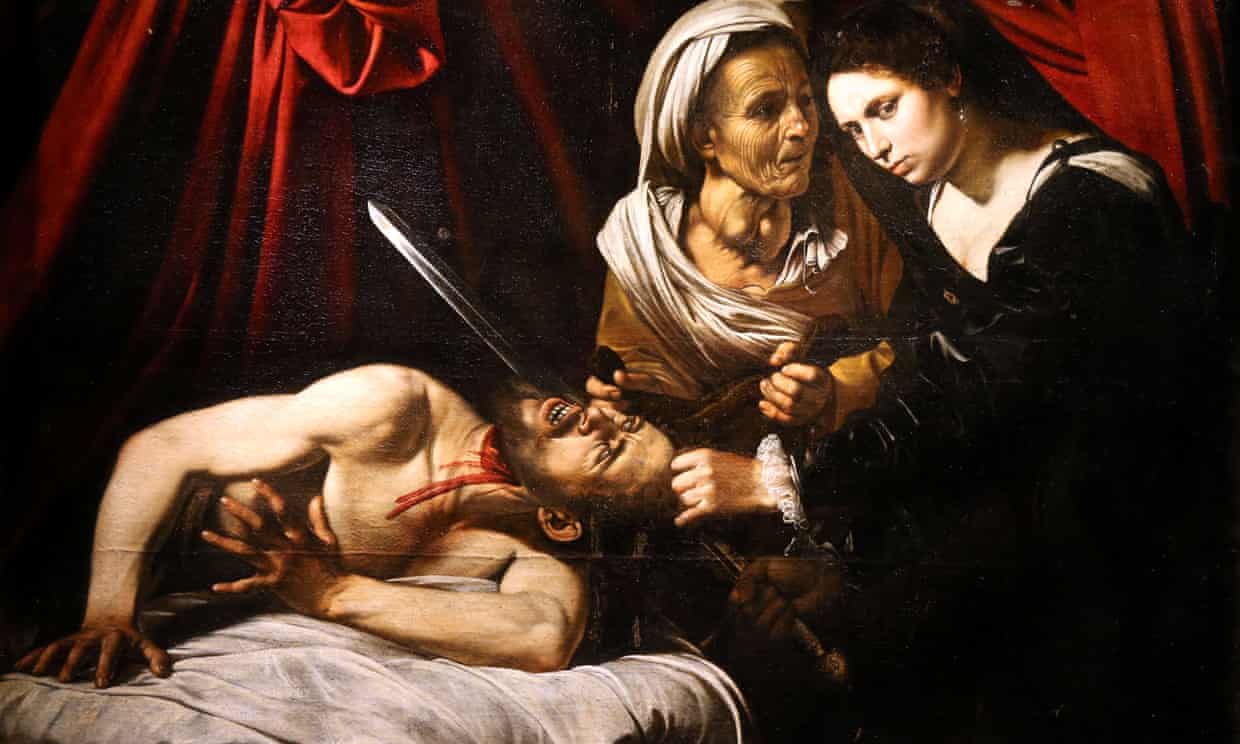
'Lost Caravaggio' found in French attic causes rift in art world


The painting Judith Beheading Holofernes at its presentation in Paris. It may have been painted by Caravaggio (1571-1610) and could be worth €120m. 

The painting Judith Beheading Holofernes at its presentation in Paris. It may have been painted by Caravaggio (1571-1610) and could be worth €120m. Photograph: Charles Platiau/Reuters

The large, remarkably well-preserved canvas of the beheading of the general Holofernes by Judith, from the apocryphal Book of Judith, was painted between 1600 and 1610, specialists estimate. And many experts believe it could be a work by the Milan-born master, Caravaggio.
Labelled the Caravaggio in the attic, France has put an export ban on the painting to stop it leaving the country while investigations are carried out.
Speaking to reporters, the painting expert Eric Turquin said it could be worth as much as €120m (£96m), describing the work as having “the light, the energy, typical of Caravaggio, without mistakes, done with a sure hand and a pictorial style that makes it authentic”.   
While other specialists have questioned its provenance, Turquin got the backing of a top Caravaggio expert, Nicola Spinoza, former director of the Naples museum. In an expert assessment seen by Agence France-Presse, Spinoza wrote: “One has to recognise the canvas in question as a true original of the Lombard master, almost certainly identifiable, even if we do not have any tangible or irrefutable proof.”
Turquin said there will never be a consensus about the name of the artist. Two Caravaggio experts he consulted attributed the painting to Louis Finson, a Flemish painter and art dealer who was familiar with Caravaggio. They say Finson possessed a number of works by the Italian master and made copies of his pictures.
“But the third expert I met told me that it was not only a Caravaggio, but also a masterpiece,” Turquin said. “Judith Beheading Holofernes must be considered the most important painting, by far, to have emerged in the last 20 years by one of the great masters.”
But the French art newspaper Le Quotidien de l’Art quoted another expert on the artist, Mina Gregori, as saying that it was not an original, although she recognised the “undeniable quality of the work”.
In a statement, the French culture ministry has said the painting should stay on French soil “as a very important Caravaggian marker, whose history and attribution are still to be fully investigated”.
The export ban means it cannot leave the country for 30 months while it is studied, and to allow French national museums enough time for its potential acquisition. The Louvre Museum in Paris has already spent three weeks studying it.
The painting, which measures 144cm x 175cm (56in x 69in) was found in April 2014, in the rafters of a house on the outskirts of Toulouse.
The family telephoned a local auctioneer, Marc Labarde, a close partner to Turquin. After using cotton wool and water to clean it, he recognised a 17th-century painting from the Caravaggio school.
Turquin kept the picture away from the public’s eyes for two years, cleaning it and submitting it to a deep examination, which included infrared reflectography and X-rays.

....

Taken from: http://www.theguardian.com/artanddesign/2016/apr/12/lost-caravaggio-causes-rift-in-art-world

Thursday, March 17, 2016

And the Assyrian Will Fall ‘by the Hand of a Woman’


http://www.pokerworks.co.uk/wp-content/uploads/2012/02/General-Holofernes.png


by


Damien F. Mackey


A Consideration of the Agent of destruction of

King Sennacherib of Assyria’s army of 185,000.


Introduction


Some scriptures attribute this great victory for the kingdom of Judah to an angel of the Lord.


2 Kings 19:35: That very night the LORD’s messenger went out and killed 185,000 men in the Assyrian camp. When they got up early the next morning, there were all the corpses”.


2 Chronicles 13:21 gives this slightly different version: “And the LORD sent an angel, who cut off all the mighty warriors and commanders and officers in the camp of the king of Assyria”.


Isaiah 37:36: “Then the angel of the Lord went out and put to death a hundred and eighty-five thousand in the Assyrian camp. When the people got up the next morning—there were all the dead bodies!”


1 Maccabees 7:41 Judas Maccabeus likewise, in a prayer, attributes it to angelic intervention: “Lord, the Scriptures tell us that when a king sent messengers to insult you, your angel went out and killed 185,000 of his soldiers”. (Cf. 2 Maccabees 15:22: “Judas said: Lord, when Hezekiah was king of Judah, you sent your angel, who killed 185,000 of King Sennacherib's men”).


The prophet Isaiah, earlier, had been somewhat more cryptic.


Isaiah 31:8: “And the Assyrian shall fall by the sword, not of man; and the sword, not of men, shall devour him; and he shall flee from the sword, and his young men shall become subject to taskwork”.


Whilst Sirach (Ecclesiasticus) will name Isaiah himself as a ‘rescuer’ of King Hezekiah’s Judah in the face of the Assyrian threat:


Sirach 48:18-20:


During [Hezekiah’s] rule, Sennacherib moved on Jerusalem,
    commissioned the field commander, and departed.
        The field commander attacked Zion,
        and made great boasts in his arrogance.
Then the people’s hearts and hands were shaken,
    and they were in agony
    like a woman who is in labor.
They called upon the Lord who is merciful,
        reaching out their hands to him.
    The holy one at once heard them from heaven,
        and he rescued them through Isaiah.


Differently again, Judith - the Jewish (Simeonite) heroine - will claim, in her victory song, that she herself had been the Lord’s agent.


Judith 16:5. But the Lord Almighty has foiled them by the hand of a woman”.


What are we to make of all of this?


This famous incident has provoked a whole lot of interpretations and hopeful explanations, going right back to antiquity. I wrote briefly on this as follows in my university thesis:


A Revised History of the Era of King Hezekiah of Judah

and its Background


A Rout Involved


Some think - based on the Hebrew word רַעַשׁ in Isaiah 29:6; sometimes translated as “blast” - that 185,000 Assyrian soldiers must have been destroyed instantly, on the spot. Perhaps by an angel of the Lord (cf. Isaiah 37:36). Or perhaps, as Velikovsky had argued, by a cosmic collision … his unique interpretation of רַעַשׁ.

For Herodotus, the agent of the army’s demise was a plague of mice. [Histories, Book 2, p. 185. Herodotus may in fact have picked up the idea of mice from the Book of Judith, according to which the Assyrian soldiers likened the emboldened Israelites to “mice, coming out of their holes” (14:12, Douay version); a typical Assyrian simile. The Greek version of the Book of Judith has “slaves” instead of “mice”].

[End of quote]


Putting it All Together


Despite the impression given by some of the above accounts of the incident, “killed 185,000 men”, “killed 185,000 of his soldiers”, “killed 185,000 of King Sennacherib's men”, common sense, I think, would tell us that - even in the greatest of catastrophes - every single person (here the sum total of Sennacherib’s army) does not die. So I would immediately prefer the version given in 2 Chronicles 13:21, whereby the angel “cut off all the mighty warriors and commanders and officers in the camp of the king of Assyria”.

This is confirmed by Isaiah 31:8, which tells of a rout and later servitude of the enemy soldiers: “… and he shall flee from the sword, and his young men shall become subject to taskwork”. And it is confirmed again in the victory song of Judith herself - a rout involving much slaughter (Judith 16:11-12):


When my lowly ones shouted,

and my weak ones cried out,

The enemy was terrified,

screamed and took to flight.


Sons of maidservants pierced them through;

wounded them like deserters’ children.

They perished before the ranks of my Lord.


The “one hundred seventy thousand infantry and twelve thousand cavalry, not counting the baggage and the footsoldiers handling it, a very great multitude” of Assyrians of Judith 7:2, an overall total of 182,000 plus, equates strikingly to the 185,000 men of Sennacherib’s defeated army. This was the massive army upon which the people of Bethulia and its environs had gazed down in horror (Judith 7:4): “When the Israelites saw this horde, they were all appalled and said to each other, 'Now they will lick the whole country clean. Not even the loftiest peaks, the gorges or the hills will be able to stand the weight of them'.”

For, as we learn from the Book of Judith, it was Bethulia opposite Dothan, in northern Israel, and not in Jerusalem, that the Assyrian army had massed and was routed. Sirach, telling of Isaiah’s rescuing of Judah, was referring to Sennacherib’s earlier successful invasion, right against Jerusalem itself.

Isaiah 31:8 uses the word “Ashur” (אַשּׁוּר), variously translated as “the Assyrian” or “the Assyrians”, and probably intending both Sennacherib’s ill-fated commander-in-chief and his massive army.

Judith, on the other hand, whose primary purpose had been the assassination of the commander-in-chief of the Assyrian army - which action became the catalyst for the Judaean victory - will focus part of her victory song on the downfall of “Holofernes” (16:6-9):


For their hero did not fall at the young men's hands, it was not the sons of Titans struck him down, no proud giants made that attack, but Judith, the daughter of Merari, who disarmed him with the beauty of her face.

She laid aside her widow's dress to raise up those who were oppressed in Israel; she anointed her face with perfume,

bound her hair under a turban, put on a linen gown to seduce him.

Her sandal ravished his eye, her beauty took his soul prisoner and the scimitar cut through his neck!


For more on this “Holofernes”, see my:


The slaughter in the Book of Judith had started in the camp of the Assyrians, and this accords with the information given in 2 Chronicles 13:21 “… angel … cut off all the mighty warriors and commanders and officers in the camp of the king of Assyria”.

It was in fact, according to Judith’s careful plan of it, a rout (14:1-4):


Judith said, 'Listen to me, brothers. Take this head and hang it on your battlements.

When morning comes and the sun is up, let every man take his arms and every able-bodied man leave the town. Appoint a leader for them, as if you meant to march down to the plain against the Assyrian advanced post. But you must not do this.

The Assyrians will gather up their equipment, make for their camp and wake up their commanders; they in turn will rush to the tent of Holofernes and not be able to find him. They will then be seized with panic and flee at your advance.

All you and the others who live in the territory of Israel will have to do is to give chase and slaughter them as they retreat’.


Judith had not only started the ball rolling. She had worked out the battle strategy as well.

But it was all based upon her total trust in God.

So, before she acts, she prays and fasts (Judith 9).

The ‘angel’ factor, common to the accounts given in 2 Kings, 2 Chronicles and Isaiah, and also I and II Maccabees, is suitably accommodated in the Douay version of the Book of Judith, according to which God’s angel, Judith’s protector, was the agent of the “victory” and of Israel’s “deliverance”. Thus Judith tells (13:20-21):


‘But as the same Lord liveth, his angel hath been my keeper both going hence, and abiding there, and returning from thence hither: and the Lord hath not suffered me his handmaid to be defiled, but hath brought me back to you without pollution of sin, rejoicing for his victory, for my escape, and for your deliverance.

Give all of you glory to him, because he is good, because his mercy endureth for ever.


Judith well knew that God alone could bring about such a victory against all odds (8:17-20):


‘… we should ask God for his help and wait patiently for him to rescue us. If he wants to, he will answer our cry for help. We do not worship gods made with human hands. Not one of our clans, tribes, towns, or cities has ever done that, even though our ancestors used to do so. That is why God let their enemies kill them and take everything they had. It was a great defeat! But since we worship no other God but the Lord, we can hope that he will not reject us or any of our people.’


Wednesday, March 16, 2016

Book of Judith Suggests Sargon as Sennacherib

by
 Damien F. Mackey

Now, there is only the one Assyrian king, ‘Nebuchadnezzar’ … ruling throughout the entire drama of the Book of Judith, and he has likenesses to ‘both’ Sennacherib and Sargon II. Thus:


• (As Sennacherib) The incident to which the climax of the Book of Judith drama could be referring, if historical, is the defeat of Sennacherib’s army of 185,000; yet
• (As Sargon II) The Assyrian king in Judith 1 seems to equate well with Sargon, inasmuch as he commences a war against a Chaldean king in his Year 12.


So it might be asked: Was the Book of Judith’s Assyrian king, Sargon or Sennacherib?
 
The question of course becomes irrelevant if it is one and the same king. See e.g. my:


The Book of Tobit was, like the Book of Judith, a popular and much copied document. The incidents described in the former are written down as having occurred during the successive reigns of ‘Shalmaneser’, ‘Sennacherib’ and ‘Esarhaddon’. No mention at all there of Sargon, not even as father of Sennacherib. Instead, we read: “But when Shalmaneser died, and his son Sennacherib reigned in his place …” (1:15).
Moreover this ‘Shalmaneser’, given as father of Sennacherib, is also referred to as the Assyrian king who had taken into captivity Tobit’s tribe of Naphtali (vv. 1-2); a deed generally attributed to Tiglath-pileser III and conventionally dated about a decade before the reign of Sargon II.
This would seem to strengthen my suspicion that Shalmaneser V was actually Tiglath-pileser III:


The neo-Assyrian chronology as it currently stands seems to be, like the Sothic chronology of Egypt – though on a far smaller scale – over-extended and thus causing a stretching of contemporaneous reigns, such as those of Merodach-baladan II of Babylonia, Mitinti of ‘Ashdod’ and Deioces of Media.
There are reasons nonetheless, seemingly based upon solid primary evidence, for believing that the conventional historians have got it right and that their version of the neo-Assyrian succession is basically the correct one. However, much of the primary data is broken and damaged, necessitating heavy bracketting. On at least one significant occasion, the name of a king has been added into a gap based on a preconception.
Who is to say that this has not happened more than once?
Esarhaddon’s own history is so meagre that recourse must be had to his Display Inscriptions, thereby leaving the door open for “errors” as according to Olmstead.
With the compilers of the conventional neo-Assyrian chronology having mistaken one king for two, as I am arguing to have occurred in the case of Sargon II/Sennacherib, and probably also with Tiglath-pileser III/Shalmaneser V, then one ends up with duplicated situations, seemingly unfinished scenarios, and of course anomalous or anachronistic events.
Thus, great conquests are claimed for Shalmaneser V whose records are virtually a “blank”. Sargon II is found to have been involved in the affairs of a Cushite king who is well outside Sargon’s chronological range; while Sennacherib is found to be ‘interfering’ in events well within the reign of Sargon II, necessitating a truncation of Sargon’s effective reign in order to allow Sennacherib to step in early, e.g. in 714 BC, “the fourteenth year of King Hezekiah” (2 Kings 18:13; Isaiah 36:1), and in 713 BC (tribute from Azuri of ‘Ashdod’).
Again, Sargon II claims ‘former’ conquests of regions though there appears to have been no follow up by him (i.e. as Sargon); the follow up being found only in Sennacherib’s records. One often has to ask, and to try to discover, if a certain event occurred in the reign of Sargon or of Sennacherib. Eponym trends, literary trends, colonisation trends (e.g. at ‘Ashdod’) can be perfectly consistent from Sargon on to Esarhaddon and Ashurbanipal, as long as the inconsistent, tradition-breaking Sennacherib is left out of the picture.


Sargon is virtually missing from Nineveh.
Sennacherib is missing from Dur-Sharrukin.


Sennacherib is missing the last decade of his Annals. Sargon is prolix about a region of campaign where Sennacherib is correspondingly brief about his own adventures in that region. And vice versa. Sargon will give a detailed account of his famous conquest of ‘Ashdod’ (identified in this thesis as Lachish); though pictorial representation of it is lacking. Sennacherib conquers the mighty Lachish, and lavishes his throne room with pictorial detail of this triumph; but hardly mentions it in writing.
These are simply I believe the two faces of the one coin, Sargon II = Sennacherib; ‘Ashdod’ = Lachish; and the two faces need to be put together if we are to make the ‘currency’ functional:


Admittedly, there are problems in connection with my revision, especially with regard to Esarhaddon’s titulary; but I think they are well outweighed by the anomalies, duplications and anachronisms resulting from the conventional structure.
New foundations are needed for, as revisionist Eric Aitchison proclaimed, “we wax so bold as to challenge this perceived snug arrangement” of conventional Assyro-Babylonian history. To establish the era of King Hezekiah on firm foundations (my thesis):


A Revised History of the Era of King Hezekiah of Judah
and its Background


one ought to take seriously that five-fold synchronism cross-checking
  1. Hezekiah and
  2. Hoshea, with
  3. the fall of Samaria, at the hands of
  4. Sargon of Assyria, who in turn has provided a chronological link with
  5. Merodach-baladan